

Cliff Honey Hunting in the Himalayas
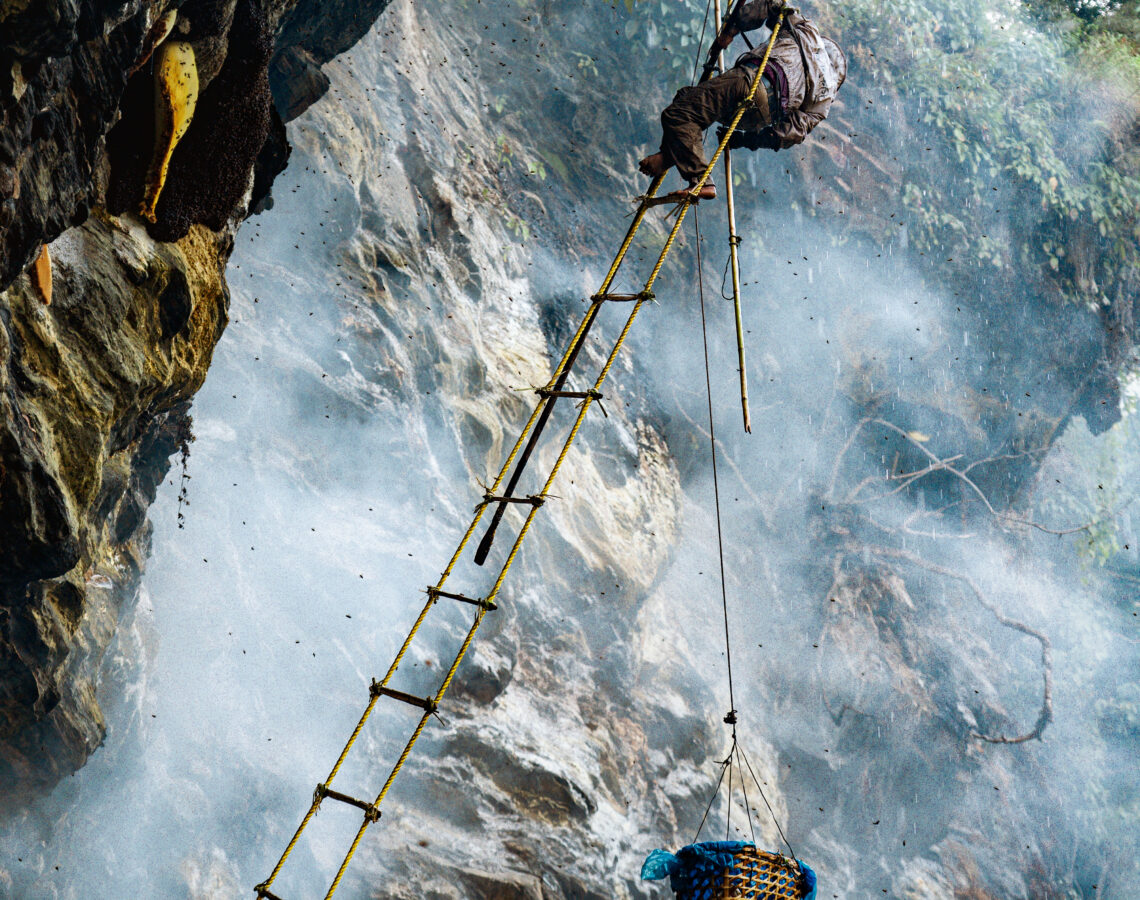
Far away from the bustle of busy streets and settlements, in a remote corner of the world, high in the mountains of Nepal, a generations-old tradition still lives on- the unique art of cliff-climbing honey hunting. Apis laboriosa, the world’s largest honey bee species, lives in the extreme conditions of this region building massive hives on cliffs that are harvested only by indigenous people climbing hundreds of metres above the forest floor.
Unlike what’s done in commercial beekeeping, where wooden hive boxes are employed to manage colonies and streamline honey extraction, indigenous honey harvesters have to ascend steep cliffs to reach naturally built hives in the wild and carefully cut the honeycombs by hand. In a single year, mature hives are harvested only twice (spring and autumn), with the entire community coming together for preparations that begin months before the harvest season.
Bees Behind the Tradition
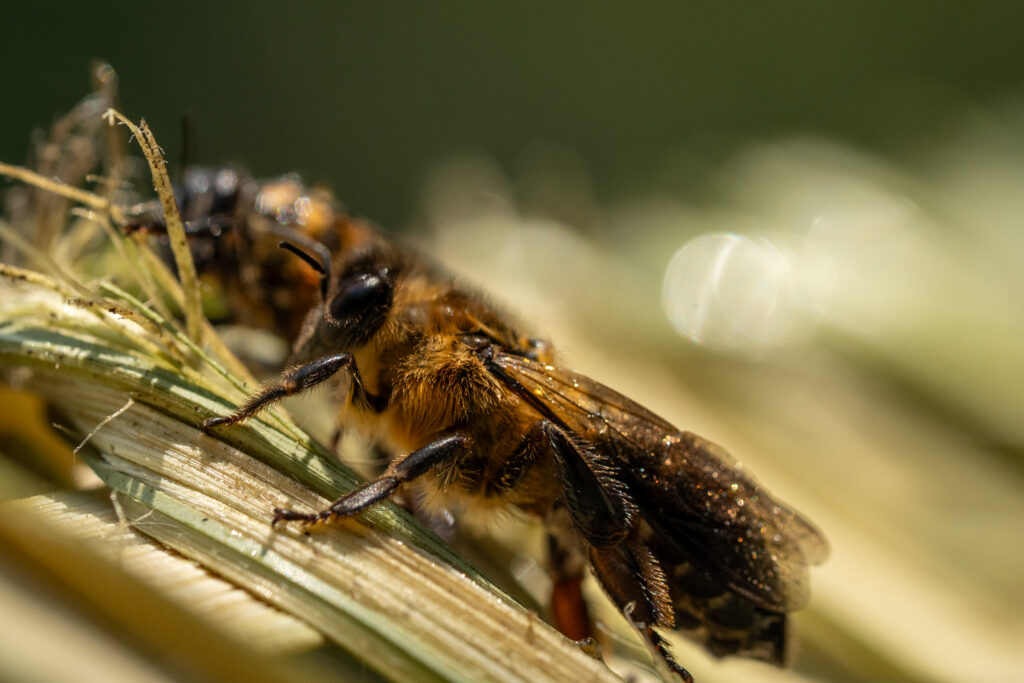
The tradition exists because Apis laboriosa has made the extreme high altitudes of the Himalayas its home. Yes! This bee species is a close relative of Apis dorsata, but it has developed remarkable adaptations suited specifically to life at these elevations. It is the largest honey bee species we know of, with workers over three centimetres long, and it lives almost nowhere else. Its range runs along the Hindu Kush–Himalayan belt through different countries including Nepal.
One single colony of this bee species builds one enormous open comb under a rock overhang, often a metre or more wide, plastered to a vertical face hundreds of metres above the valley floor. There is no hollow tree to cut open and no box to lift a lid off. If you want the honey, you have to go to the cliff.
Over the period of evolution, they developed a robust body allowing them to forage on huge mountain forests in cold, thin air where most pollinators simply cannot fly. In spring, they get to forage on bright rhododendron forests across the highlands, making their honey unlike most varieties. The grayanotoxin compound from rhododendrons gives the Himalayan honey its characteristic bitterness and a distinct sense of mental relaxation- the property that has made mad honey recognised around the world.
How Himalayan People Hunt Honey
The gear is built by hand, usually in the weeks before the harvest as the whole community comes together to prepare for the harvesting day.
The ladder is woven from bamboo strips and rope, long enough to from the base of the cliff to a point beyond the comb. Village-made ropes take the weight of the ladder and of anyone on it. The cutting tool is a long bamboo pole with a blade or a sharpened edge lashed to the end, because the hunter has to reach and slice through wax while hanging in open air. Another rope carries a wide basket that sits under the comb to catch the pieces as they fall.
Nobody does this alone. A single harvest can involve a dozen people or more, and everyone has a job.
Asking Permission First

Before any of it begins, the village priest sets the date. He reads the calendar and the omens, and the preparation only starts once an auspicious day has been named.
On the morning of the hunt, there is a puja at the base of the cliff. Flowers, rice and local chicken are offered to appease the forest gods. In many Gurung villages, the offering is made to Rangkemi, the spirit associated with the bees and the rock. The idea is not that ritual makes the climb safe. It is that the honey belongs to something else first, and you ask before you take it.
The Harvesting Day
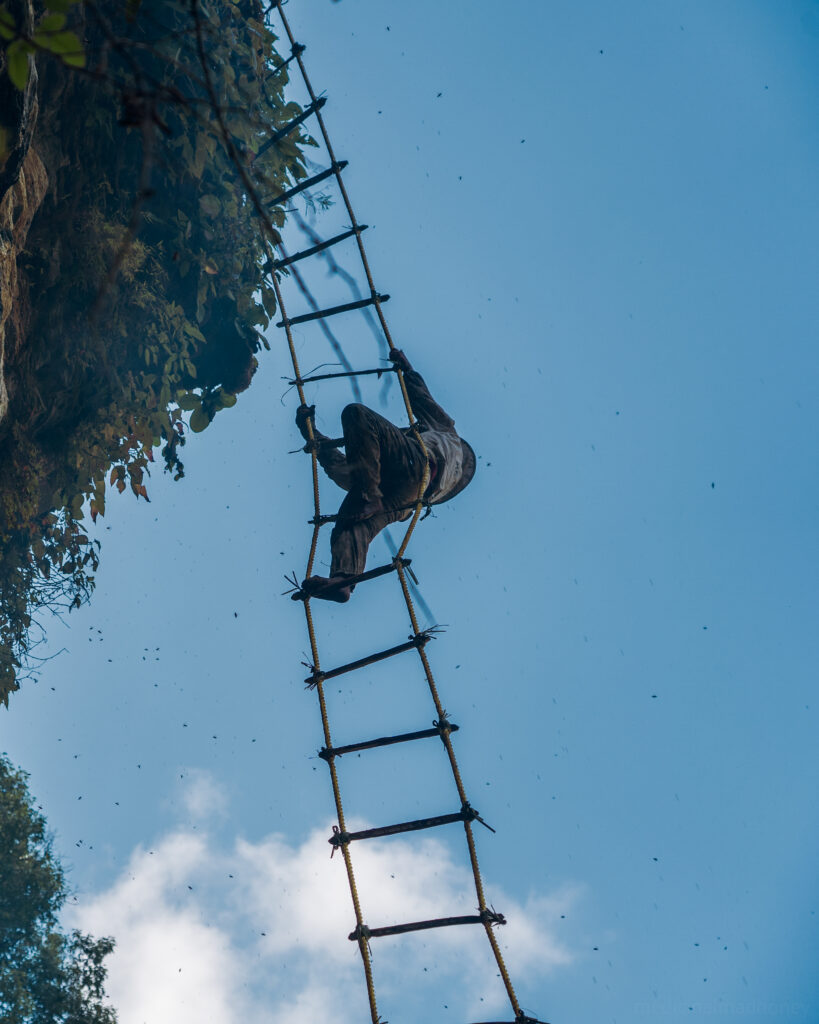
The ropes go on first. The anchor team secures the ladder at either the top or the base, depending on the terrain, then pays it down the cliff face while others keep the guide lines steady.
Then the fire is lit at the base. Damp grass and green leaves make thick smoke, and the smoke does something specific: it swamps the alarm pheromone the guard bees release, so the colony scatters instead of mounting the coordinated attack it would otherwise mount.
The lead hunter goes over the edge. Everything from here is done by feel, one rung at a time, on a ladder that turns under him. Protection is usually a wrap of cloth and a hat with netting, sometimes nothing at all, which is the detail visitors find hardest to believe.
At the comb, he chooses. Mature sections holding capped honey are cut away. Brood comb and a portion of the nest are deliberately left behind so the colony can rebuild. The cut pieces drop into the basket, and the basket goes down to the ground team on a line, or up to the top, depending on the cliff.
Then he moves along the face and does it again until all the mature hives are covered.
The Practice Promising Sustainability
Restraint is built into the method rather than bolted on afterwards.
Only mature hives are taken. Part of every nest is left standing. Harvests happen twice a year, in spring and in autumn, and communities rotate the cliffs so the same colonies are not stripped season after season. Modern extraction has been kept off these cliffs, partly because it does not work on an open comb, and partly because these communities have not wanted it there.
Meanwhile, the bees keep doing the other half of the work. Between harvests, they pollinate the alpine and subalpine flora across a landscape where almost nothing else of their size can operate, which matters more than the honey does.
How the Honey Became the Boon
For most of this history, the honey was food. In villages with a short growing season and long winters, a comb that yielded litres of honey you could store was worth risking a cliff for.
It is now also income. Cliff honey sells at high prices in Kathmandu and abroad. Alongside that, apitourism has grown fast. Villages in Lamjung such as Bhujung and Ghanpokhara, and Ghalegaun over in Kaski, now host visitors from different regions who come specifically to watch a harvest. Guiding, lodging and feeding those visitors has become a second income stream for households that had very little.
The money brings its own problems. Honey worth several hundred dollars a kilogram creates pressure to cut more comb, but still the communities haven’t compromised. Still, they have maintained practices that allow the harvest to continue while protecting the bees and their habitat.
A Relationship More Than Honey: The Mountain Ecosystem
The honey hunting practice might appear as a general practice to outside observers, but for the communities who have practiced it for generations, it is much more than that.
Long ago, when people didn’t have a reliable food source, that’s when they discovered this honey. Over generations, it became more than a source of food; it became part of the relationship between the communities and the bees. The bees came to be regarded as providers, giving families food that could be stored and used throughout the year. That history is at the heart of the respect these communities have for the bees today.
On the other hand, the harvesting practices that local communities have followed over generations have also helped protect the colonies. Harvesters leave parts of the hive behind so the bees can rebuild and they never prioritize overharvesting. They work with the local community to protect the hives and avoid methods that could damage or destroy the colonies. These practices have allowed honey hunting to continue while giving the bees the best chance to survive and return to the same cliffs.
In the process, the bees also pollinate the alpine and subalpine floral systems, making them especially important in an environment where harsh conditions limit the number of pollinators that can survive at high elevations. The bees support the mountain ecosystem, the ecosystem sustains the bees, and generations of communities have learned to harvest from that relationship without breaking it. That balance allows honey hunting to remain a living tradition in the Himalayas.
References
- https://medicinalmadhoney.com/blogs/mad-honey/hunting-mad-honey-in-nepal
- https://www.researchgate.net/publication/389195271_STATUS_AND_PROSPECTS_OF_HONEY_HUNTING_IN_ECOTOURISM_AND_RURAL_LIVELIHOOD_IN_LAMJUNG_NEPAL
- https://cliffhoney.com/blogs/honey-guide/cliff-honey-harvested
Thanks to Deepa Pudasaini of Cliff Honey for this guest blog post! All photos courtesy of and credited to Cliff Honey.


Leave a Reply